-->
Showing posts with label Indian architecture. Show all posts

How to buy an apartment based on Vastu compliance?

Recapturing the gist of my previous blog Vastu: The profound sense of dwelling, I can assure you that the knowledge of Vastu is really essential while buying or making a dwelling. Nowadays, people interested in turnkey-based projects don't want the hotchpotch involved in making a perfectly finished house with all other extra included facilities. Facilities like security services, clubhouses, dedicated parking areas, children's parks, recreation grounds, community halls, swimming pools, gym, installation of Water Treatment Plants, Sewerage Treatment Plants, Generators, fire protection system, camera surveillance, etc. can't be mitigated by a single residential owner. Therefore, the consumer push is more toward the big real estate projects like apartments, simplexes, duplexes, and villas. People are also flooding the urban areas and a differential shift to urbanization is also causing this demand. To meet this rising demand many builders and real estate agencies are growing in numbers difficult to reckon. Some of them are deceiving and showing fraudulent projects just to boost their sell and gather money from the ignorant customers.

When it comes to the Vastu of apartments, traditional Vastu rules fail in many regions. Many contemporary Vastu consultants also hesitate to audit the Vastu of a flat or apartment because of its multiplying complexities. During the origins of Vastu Shastra nearly 5000 years ago, there were no apartments or flats, so the gathered principles of traditional Vastu had not encountered today's modern designs and architecture. But with proper assessment of the fundamental principles of Vastu, it can also be applied to flats and apartments.

Hence, in this blog, I will define the Vastu compliances vividly for a common buyer trying to buy an apartment in the coming future. I have also written: How to buy an apartment? and Websites to look upon while buying an apartment in Odisha. Please go through them for an initial understanding of how to buy an apartment and acquire all the legal documents online while buying an apartment in Odisha.

The suitable Vastu of an apartment can be derived from different parameters such as the position and movement of the Sun, the relative motion of the moon, the direction of the wind, atmospheric parameters like temperature, pressure, etc., climatic and seasonal changes, horoscope of the owner or builder, flow of energies and radiation in the apartment, magnetic fields and other invisible forces, location of the source of water, the colour used in the apartment, textures, obstructions, damage in the apartment, etc, etc. 

Direction is considered as the most important factor in Vastu and hence it has been divide into 4 major and 4 sub directions. The 4 major directions as we know are East, West, North, South and the four Sub- directions are Northeast (Eshan), Southeast (Agneya), Southwest (Nirutya/Nairutya), Northwest (Vayaya). The 9th direction is the top perpendicular direction to all these 8 directions called the space (Akash or Mahaakash)  and the 10th direction is considered as the bottom perpendicular direction as hell (patal). 


North is governed by Kuber; the deity of wealth and prosperity. The planet attached to this direction is Mercury (Buddha). As per the magnetic poles, the magnetic field lines flow is from north to south direction and we also know that the field lines originates from positive and descends on the negative side. This implies that the north is a source of positive energy and the apartment or flat having a north entrance will always be positive, abundant, open to possibilities, more into giving rather than taking, etc. etc. The geographical north is also 10 to 12 degrees apart from the magnetic north. So, the 1st quadrant 2/4 or 3/4 position is considered as the best position for the entrance. 

South is the bank of all good energies of North. It is at that end where the magnetic field lines disappear. Hence there shouldn't be big openings on that end. This direction is governed by the planet Mars (Mangal). Hindu deity residing in this direction is Yam; the deity of death. Yam is always considered as the taker of lives. So, there will always be more of a taking element rather than the giving one. Therefore, the south entrance is contemplated as impoverished or enervated and is always closed mostly. However, there's one section of the 4th quadrant(Southeastquadrant) i.e. the 4/4th section which is considered auspicious and can be taken into account when planning for a south entrance. Implying the 10 to 12 degrees tilting rule between geographical and magnetic south. the 4/4th section is that point where the magnetic south rests. This magnetic south is that point where all the mag lines submerge making it the best receiving section. 

The East direction is powerful. The deity residing nearby is Indra; the deity of rain and thunder adjacent to the deity Surya. The direction is governed by the biggest celestial body of the solar system; the Sun (Surya). Sun has the highest impact in each and every term from all other planets. Hence making this direction the strongest of all. Sunrises in the east and therefore, the east direction is always lighted, kept more open, clean, etc. Some of the best Vastu apartments give more openings in this direction mostly. Making heavy walls, staircases, accommodating a toilet in this direction is considered as an offence in the Vast rules. East is considered as the best for entrance. 

The West direction is where the sun sets and hence it symbolizes stability in life. Varun; the deity of Rain, fame, fate resides in this direction as per Vastu Purusha Mandala. Saturn (Shani) is the governing planet of the west. Big openings in this direction will result in the dissipation of the solar energy stored from the east. As an entrance, you can go for the west. However, entrance in the north-west quadrant will be better than the south-west quadrant. In the Vastu Purusha Mandala, the deities residing in the west side padas are Raga, Yama, Sesa, Asura, Varuna, Pusya, Sugriva, Nandi and pitara. So, the 3rd, 4th, 5th and 6th padas are considered good for the entrance when compared to an east entrance. 

As per Vastu Purusa Mandala, the Northeast direction (Eshan kon) is governed by Isa; another name of Shiva. The representative planet for this direction is Jupiter (Brihaspati). It is the most dominant direction if considered in terms of Vastu. Irrespective of your horoscopes and psychology, it has its own piousness in providing a positive mentality, a creative perspective for every action performed there. The magnetic axis starts from northeast to south-west making it the rejuvenating source of positivity. The best place for a water source can be dug in from here. The best corner for worship and the best place for concentration and creativity is found in this direction only. Being ruled by the water element it is also recommended to water fountains in this corner. It is also important to leave much open space in the Northeast direction as it is a beneficiary source of rain, wind and sunlight combined. 

The Southeast direction (Agneya Kon) is the place of the fire element owned by the fire deity; Agnidev. The representative planet for this direction is Venus (Shukra). Scientifically, this is that quadrant where the sun is in its hottest phase making it suitable for fire-related works. Anti elements like water and wind shall not be taken in from this corner. The use of the Southeast is a delicate matter and planning should be very precise while designing this corner.

The Southwest direction (Nirutya/Nairutya Kon) is owned by Pitarah and the corresponding celestial body for the southwest is Rahu. Rahu is the north lunar node (ascending moon) and along with Ketu is considered as a shadowed moon in eclipse. magnetic energies flowing from the northeast meet in this quadrant. Southwest if planned properly can give health, wealth and prosperity in abundance. Being governed by the earth element, the Southwest ground level must be a little higher than the other corners. Southwest must be enclosed with thick walls with proper ventilation. A proper room for the owner or master of the dwelling. Bad southwest can affect mentally causing trauma, stress, depression and anxiety. 

Northwest corner (Vayaya kon) is governed by the deity Vayudev; the God of winds. The celestial body in this direction is the moon. The wind being the element of abundance there, can make this place a li'l unstable. It shows 315 degrees in the directional compass. This direction is good for gardening and plantation, good for balconies and open-air spaces but not a good place for storage, basement or water source. The kitchen is a strict no in this area. However, considering many salient Vastu rules we can also change the plans for the benefit of the owner.

Below are certain broad points about Vastu compliance you all should check before buying an apartment.

1. Society Vastu: Entrance of society, facing of the society, placement of generators, positions of swimming pools, the position of water source like boring or sump/tank in the Northeast corner and position of the sewerage unit, soak pit, drains in the Northwest, North or West direction etc. Northeast is never an option for stairs, guard's room or servant's room. Ask for the complete layout of your apartment from the builder or owner. Check the orientation of the whole apartment as well as your flat.


2. Vaastu of your apartment: Parkside facing flats, roadside facing flat, Maha Dwaar exalted, Balconies directions in East direction or North direction, North / Northwest / East / 4th block of Southeast quadrant facing entrance mostly. The Northeast corner must have the pooja room where deities are to be shrined. Keeping kitchen, toilets, stores and servant room in this corner is not accounted good. Southwest corner must be picked for the master bedroom where the head of the family will reside. West or south is also preferred for drawing or hall. The Northwest corner can be for study/ childrens' rooms/ drawing room/ living area/ hall/ guest room etc. Bathrooms must be present in the south or west direction only. The kitchen is to be present in the southwest direction as it is the fire element corner of the flat. The most preferable positions of windows are in the east or in the north direction. Windows opening inwards is a must check in houses using traditional window design. Based on Pada Vinyasa, Veethi vinyasa and Marma sthaan the planning of the house is done. Along with that Ayadi Shadvarga calculation is done.


3. Ownership hand: The house must be newly painted, check the history of the previous owner, Vastu Pujan or Grihaprabesh puja is to be done before dwelling in any house. Make this a strict point not to use old owner's left belongings, etc. If you are buying an old apartment always check for cracks, seepages and leakage areas, functioning of the switches and sanitary wares. If there's any electrical appliance installed do check its functionality also. Do a well to do repair if you find any issues in the above-mentioned points. 

5. Grihnada Vastu ( House owner's compatibility)- Compatibility between the Nakshatra of the house owner and house, test for determining body constitution (Vata-Pitta-Kapha) of the house owner and the results based on the same - such as which bedroom is auspicious for him, etc. Suggestions based on the Job of the house owner and Ekayoni checks based on the same. etc. The matchmaking of the land horoscope and the owner's horoscope is also done for better results.

6. Antarika Vastu (Interior design )- - Results based on the placement of Cot, Chair, washbasin, fridge, AC, etc. Within each room inside the house are taken into consideration in this section. Positions and orientations based on each element inside the house are considered using Vastu principles only. The use of paint, colour selection, wallpaper shapes, etc are also depicted based on the Vastu principles.

7. Muhurtha- In Vāstu, an auspicious moment with the best Muhurta is selected for each stage of work to be started. Such a Muhurta itself gives long life to the construction. Starting work without auspicious Muhurta is just like giving treatment to a dead. One can conclude that however well the building might be constructed as per the principles of Vastu if the important Muhurta combinations are not achieved to the owner is likely to suffer the effects of bad Muhurta as enunciated and outlined. A proper Muhurta should be made use of; otherwise, the very purpose of big projects is likely to be lost. Proper muhurta must be observed so that the Vāstu constructed on such land would last long. The muhurta must be selected on astrological rather than religious considerations. While selecting a muhurta, the astrological principles rather than religious ones should be observed very carefully.


After saying all these points, I would also like to conclude by saying that no direction is good or bad, it's the house planning based on the utility which either makes it good or bad. So, as per my recommendation whenever you choose to buy an apartment/ flat/ simplex or duplex for your dwelling always consult a Valid Vastu Consultant. If that's not happening then at least shortlist some salient points from this blog and do a crosscheck with the house you are going to buy. It is not a matter of days or months, it will be a lifelong asset that will have direct interaction and influence in your life. So choose wisely! IF you have any doubts regarding any issue, you can consult with me by sending me a comment on this blog or just pinging me will do. 
Share:

Vastu: The profound sense of dwelling


Recapturing the long lost trend, nowadays the common sense of civilized and progressive people are recognizing the importance of houses more than that of the importance of food and clothes. It is very evident to say that a house and its making impact a person's life more in terms of time and transactions. It is being reaffirmed that among the amenities of life, a residential building not only affords a large degree of comfort and convenience but also significantly influences health, relationship, longevity, safety, and security. 

Earlier in ancient times, constructing a house or any building in (Bharat) India was deeply associated with a holistic and spiritual approach. Being the hub of cultural integrity, India was developing its architectural front based on rudimentary searches and research. Vedas, Puranas, and Upanishads were encrypting many such architectural findings and principles under the rishis(sages), gurus (Teachers), sishyas (scholars), sthapatis(architects, builders, and designers) as well as silpis (carvers and workers). Apart from that, many Sahityas(literature), agamas(religious texts), itihasas(historical texts), kavyas(poems), Sangitas(songs), Natya shastras(dramas and ethology), etc. have traces of architectural material in them. These ancient Hindu architectural texts are collectively stated as Vaastu Shastra or simply Vastu. Vaastu or Vastu has come from the word 'Vas' which means living in a certain place. The literal meaning of Vastu is the place where we live or dwell. Vastu shastra has its origin from sthapatya Veda which is a crucial part of Atharvaveda. Some of the most important ancient works related to Vastu are Viswakarma Vastu Shastra, Samaragana sutradhara, Mandana Sutradhara, mayamata, silparatna etc. Agamas like suprabhedagama, karnikagama, Vaikhanasagama Maha-agamas etc. and Puranas like Agnipurana, Matsyapurana, garuda purana etc. are noticeable works of Hindu architecture.


In India, Vastu is given the utmost importance while creating a dwelling because most of the architectural magnum opuses of earlier days were created strictly following the Vastu norms and principles. Vishwakarma is considered the supreme architect and his descendants are also identified with the creation of much monumental architecture following the principles of Vastu only. Vishwakarma is credited with the craftmanship of many weapons and chariots of Gods in Hindu mythology. In Ramayana and Mahabharata, he is also identified as the planner and creator of cities like Lanka, Dwarka, and Indraprastha. Mayan or Mayasura being the son of Vishwakarma and father of Mandodari is also considered as the planner of Mayasabha(coliseum) and cities of Lanka and Dwarka too. Nala, another son of Vishwakarma was the sole architect behind the construction of Nala Setu or Ram Setu. There are also architectural texts based on Vastu for Jainism and Buddhism such as Gautamiyam, Bauddhamatam, Caitya, etc.

Manasara is a Shilpa Shastra(the science of art and crafts), written by multiple authors successively evolved over the centuries. Inside its 70 chapters and 10,000 shlokas, it has vividly described topics like the system of measurements, qualification of an architect, objects of architecture, selection of construction site, soil testing, ground plans, village planning, town planning, foundation design, column design, design of palaces, chariots, Hindu temple architecture, the structure of deities as well as Jaina and Buddhist temple design and construction, etc. 


Mayamata is a valuable work of Vastu architecture written by Maya or Asuramaya or Mayan in Sanskrit. Mayamata means the opinions of Maya in architecture. It contains 36 chapters and 3300 slokas. 300 slokas are related to planning, other 3000 are related to measurements, soil testing, site selection, building material, length and width ratio, etc. Chapters like samria sangraha, Bastu Prakara, Bhumi Pariksha, Bhumi adhigrahan, Padavinyasa, Bali Karma, grama niyojana, nagara niyojana, Garbha binyasa, Upapitha, adhisthana, stambha, lupas, sandhi karma, sikhara, eka/dwi/tri manjila nirmana, Gopuram, Mandapas, Griha, Griha prabesha, dwara, Bhumi, bhawana, Bahana, Linga Bidhana, Petha Bidhana, Zirno Uddhara, etc. are included in Mayamata. 

Brihat Samhita, the most specialized work of Varaha Mihira also describes any architectural principles. Brihat Samhita has 100 chapters and 3900 slokas. It talks about astrology, mathematics, architectural science, sun and its significance, planetary motion and their significance, planetary years, meetings, moon's conjunction with celestial bodies, constellation's impacts, wind and its importance, climate and seasonal changes, time and calendar, etc. Varaha Mihira was inspired by many poets (mostly by Kalidasa) and authors from whom he extracted many evident implementations. Thus the word 'Samhita' literally means amalgamation. Brihat Samhita also describes the design of Nagara-style temples built in the 6th century.

Vastu shastra has also proliferated its impression on modern architectures. The scientific and rational minds have accepted it with an open approach in the form of guidelines, scrutinized its important aspects, and extracted the benefits in their implementation. Some of the modern architectural marvels based on Vastu are as follows:

1. City planning of the city of Jaipur, Rajasthan by Rajput king Jai Singh in 1727.

2.Gandhi Smarak Sangrahalaya, Ahemedabad, Gujrat 

3. Lotus temple, New Delhi by Fariborz Sahba in 1986

4.Jawahar Kala Kendra, Jaipur, Rajasthan by Charles Correa in 1986

6. City planning of Chandigarh, by Le Corbusier

7. Ram Mandir, Ayodhya, under construction, by Sompura Family started in August 2020 

Suitable Vastu is derived from different parameters such as defining the location of the plot of construction based on direction and altitude, the position and movement of the Sun, the relative planetary motion, the relative motion of the moon, the direction of the wind, soil qualities of the plot, atmospheric parameters like temperature, pressure, etc., climatic and seasonal changes, specific time selection about the calenders, horoscope, and behavior of the owner/ maker/ creator or builder, flow of energies and radiation in the plot and building, magnetic fields and other invisible forces, material selection parameters, location of the source of water, etc, etc. 

Vastu is based on the 5 elements principle. The 5 fundamental elements of creation are Prithvi (Earth), Jal (Water), Aakash (Space), Vaayu (Air), Agni (Fire).  As we know, a living being is made up of five elements similarly the Vastu is considered to be a living being and is created out of five elements too. The effect of each element changes from direction to direction. The most effective element in the northeast direction is considered to be water, whereas the southeast direction gives more importance to the fire element. The northwest and southwest directions consider air and earth as their most effective element respectively.  The astrological studies of horoscopes have also denoted different elements to different horoscopes. So, linking both the astrological insights with the Vastu Shastra, proper orientation to the site plan can be proposed. 


The science of directions is used to derive a suitable site plan followed by a suitable floor plan of the building. The concept of Vastu Purusa is used here to ease the complexities of the plan. As Astrology goes with the personification of time (The Kala Purusha), similarly Vastu Shastra deals with the personification of space (The Vastu Purusa). In fact, ancient sages knew the relation between space and time. And based on their intuitive wisdom, they established a space-time personified concept to access this wisdom. In the Vastu Purusha concept, the site is divided into specific no. cells called Padas. The site plan (Pada Vinyasa) is done by planning each cell and allocating suitable functions to each dwelling cell. Every pada or cell is denoted with a certain deity bearing a certain form of energy. 

Division of plot using horizontal and vertical lines into a specific number of squares. They range from 1x1 to 32 x 32. Vastu Purusha mandalas uses pada vinyasa for divisions. Different mandalas have specific no of padas based on types of pada vinyasas. The most prominent Vastu Purusa Mandalas are Chhandita Mandala(8x8) with 64 padas and Parasaayika Mandala (9x9) with 81 padas. The Manduka/ Chhandita Vastu Purusha Mandala (8x8) is mostly used for layouts of Hindu temples. The Parasaayika Mandala (9x9) is mostly used for deep value intended Residential/ commercial planning. While dividing the energies of the padas, a particular deity was represented corresponding to their energy characteristics. In the Parasaayika mandala, the normal position of the Vastu Purusha (head towards northeast and legs in the southwest) is depicted, and along with this orientation of Vastu Purusha, a total of 45 energy deities sit upon him.
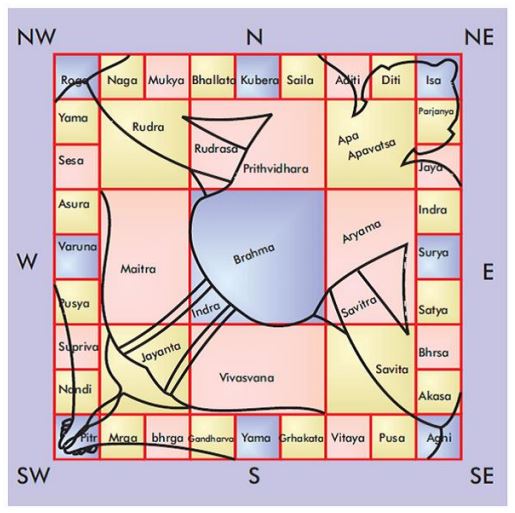

While constructing a building, Vastu gives step-by-step guidelines starting from the selection of the plot or site to the finishing of exteriors and interior planning. A brief description of the steps has been given for your convenience.

1. Plot / Land selection (Bhu-Vastu):- Vastu plays a very important role in the plot selection for residential as well commercial use. The shape of the plot, the orientations, and directions of the plot, type of soil, tilt/ slant of the land, proximity of the land (landmarks such as temples near the land, roads near the land, water source near the land, etc.) help in determining the quality and fitness of the land for further construction. The soil is divided into 3 types based on its quality, viz., High (Uttama), medium (Madhyam), and low (Adhama). Further, the soil can be examined base on its taste (rasa), color (varna), touch (sparsa), smell (gandha), etc. Purification of the soil, possession of the plot, dividing the soil into grids, etc. are also included in Bhu-Vastu A land horoscope can be taken out for better understanding and implementation. 

2. Division of segments or sections (Khanda Vastu)- It is more of a calculation based on different forms of division of the plot. Veethis (concentric circles) and padas (grid Square) are used to divide the plot based on the plot size. Veethi vinyasa and Pada Vinyasa are done to allocate different spaces of use based on the relevance of the segments. Marma Bindu (Vital points) are also defined while dividing the plots

3. Griha Vastu (House Design)-  Based on Pada Vinyasa, Veethi vinyasa and Marma sthaan the planning of the house is done. Along with that Ayadi Shadvarga calculation is done. Six types of Ayadis are calculated ( Aaya – Income/benefits, Vyaya – Expenditure, Yoni – Direction indicating the flow of energy (Prana), Varam – Weekdays, Nakshatra – Star,  Amsa – Quality/feature). Tithi, Yoga, and Ayuva are also calculated there. A proper foundation method, plinth, column, beam, roof, door, window, etc. are selected based on the type and no of stories. Starting from the footing to the roof, everything is calculated as per the Vastu principles. Direction based results for every kind of rooms, results based on obstructs (vedhs and dosas), results considering the position of well, septic tank, soak pit, water source, results for the main gate, compound wall, staircase, etc. are also calculated based on the Vastu principles.

5. Grihnada Vastu ( House owner's compatibility)- Compatibility between the Nakshatra of the house owner and house, test for determining body constitution (Vata-Pitta-Kapha) of the house owner and the results based on the same - such as which bedroom is auspicious for him, etc. Suggestions based on the Job of the house owner and Ekayoni checks based on the same. etc. The matchmaking of the land horoscope and the owner's horoscope is also done for better results.

6. Antarika Vastu (Interior design )- - Results based on the placement of Cot, Chair, washbasin, fridge, AC, etc. Within each room inside the house are taken into consideration in this section. Positions and orientations based on each element inside the house are considered using Vastu principles only. The use of paint, color selection, wallpaper shapes, etc are also depicted based on the Vastu principles.

7. Muhurtha- In Vāstu, an auspicious moment with the best Muhurta is selected for each stage of work to be started. Such a Muhurta itself gives long life to the construction. Starting work without auspicious Muhurta is just like giving treatment to a dead. One can conclude that however well the building might be constructed as per the principles of Vastu if the important Muhurta combinations are not achieved to the owner is likely to suffer the effects of bad Muhurta as enunciated and outlined. A proper Muhurta should be made use of; otherwise, the very purpose of big projects is likely to be lost. Proper muhurta must be observed so that the Vāstu constructed on such land would last long. The muhurta must be selected on astrological rather than religious considerations. While selecting a muhurta, the astrological principles rather than religious ones should be observed very carefully.

Vastu Shastra is itself a vast topic to grasp. Years of proper training and learning are required to get the essence of Vastu Shastra. To fulfill the regularity of the format a conclusion is needed to be drawn. And after reading this blog you might have got the gist of the topic. Vastu shastra is indeed a profound sense of dwelling and must be taken into account while building or buying a house, planning a village or city, planning of landscapes, planning of commercial as well as residential buildings, and many more. 

Share:

Popular Posts

Recent Posts