Bhubaneswar is no longer a city preparing to grow. It is a city that has already crossed that threshold and is now deciding what kind of growth it will live with. The expanded BDA limits, the twin-city relationship with Cuttack, the fast-transforming gram panchayats around Chandaka, Jatni, Khordha Road, Pahala, Balianta and Balipatna are not future concerns. They are the present city, behaving urban in every way except governance clarity.
This is the phase where cities usually make their most expensive mistakes—not by doing the wrong things, but by delaying the right ones. Solid waste management and litter control fall exactly into this category. When roads are new and buildings are rising, waste feels like a secondary issue. But once habits settle, correcting them becomes far harder than setting them correctly in the first place.
The problem Bhubaneswar faces today is not lack of rules or absence of schemes. It is the quiet confusion of responsibility, especially in the expanding edges. Inside the older municipal core, systems exist. Outside it, in newly absorbed layouts and village-turned-urban settlements, garbage does not know who it belongs to. Panchayats assume the city will take over. Municipal bodies hesitate beyond formal limits. Development authorities focus on approvals, not daily waste. Garbage thrives in these gaps.
Cities like Delhi and Kolkata did not become overwhelmed overnight. They slowly accepted disorder as normal. What began as temporary inconvenience hardened into permanent dysfunction. Bhubaneswar still has something those cities lost early time. And timing matters more than money.
The most effective intervention lies at the block and local level, where administration meets everyday life. Blocks and BDOs are uniquely positioned to manage the transition zones between rural governance and urban reality. The gram panchayats surrounding Bhubaneswar are no longer purely rural. Treating them as such will only accelerate disorder. Waste management here must be seen as city preparation, not village housekeeping.
The first correction is clarity. Every road, drain, market, settlement, and vacant plot within the expanded urban influence must fall under a clearly named authority—BMC ward or specific block administration. No space should exist without ownership. Garbage appears only where responsibility dissolves.
The second correction is predictability. Waste collection must be regular, visible, and known. Each block and peripheral zone needs a fixed number of vehicles, fixed routes, and fixed timings. When people know exactly when waste will be lifted, behavior adjusts quickly. Irregular systems train people to dump. Regular systems eliminate the excuse.
Public dustbins must follow human behavior, not paperwork. Markets, food streets, bus stops, vendor clusters, apartment entry points—these are where waste is generated. This is where bins must exist, be maintained daily, and be emptied visibly. Clean infrastructure is not cosmetic; it is behavioral guidance.
Vendor spaces deserve special attention. Every licensed vendor or shop already occupies public space. That space should come with gentle responsibility. A clearly marked small area in front of the stall, supported by nearby bins and predictable lifting, creates ownership without fear. Cleanliness improves when people feel the street is partly theirs, not when they feel watched.
Enforcement alone will not work here. Bhubaneswar’s strength lies in its people. It is a city that responds better to participation than pressure. Awareness programs, local clean-up drives, and open-street or Raahgiri-style mornings, Ekamra walks with fused cleaning drive do something fines cannot. They make cleanliness visible, social, and shared. When streets briefly belong to people instead of vehicles, behaviour shifts.
Schools are the city’s most underestimated allies. Government schools, Saraswati Shishu Mandirs, and public and private institutions alike shape daily habits at home. When children participate in cleanliness drives, adopt streets or ponds, or compete in simple civic challenges, families follow naturally. Inter-school programs involving institutions like Sai International, ODM, DAV, DPS, KIIT and others can anchor cleanliness into the city’s culture rather than its rulebook.
Equally important are the people who keep the city functioning every day. Sanitation workers, SHG members, and field staff understand the city at ground level better than anyone else. Recognition matters here—not quietly, but publicly. Awards, felicitations, incentives, and visible appreciation create pride. A city that respects its workers rarely stays dirty for long.
Recognition should extend to citizens as well. Households that segregate waste properly, lanes that remain clean, communities that cooperate deserve acknowledgment. Cleanliness spreads faster through appreciation than through punishment. Policies must ease adaptation, not create anxiety. Support must come before enforcement, and enforcement must always remain the last step.
Bhubaneswar is approaching a point of no return—not in crisis, but in habit formation. Infrastructure is rising. Population is increasing. Consumption is accelerating. This is the moment to lock systems in gently, before disorder feels inevitable. Cities do not decline loudly. They decline quietly, through tolerance of mess, confusion of responsibility, and delayed decisions.
This is not an alarm. It is a reminder of timing. Cleanliness is easiest to build before it becomes urgent. Coordination is simplest before conflict appears. Bhubaneswar still has clarity, scale, and civic goodwill on its side.
Clean now. Coordinate now. Humanize the system now.
Later is always louder. Now is still calm enough to act.
REVISITING THE NON- NEGOTIABLES
Clear Area Ownership
Every road, market, drain, and vacant plot must be officially assigned to a specific ward, block, or panchayat authority. Garbage reduces automatically when there is no confusion about who is responsible.
Fixed Collection Timings
Waste must be collected at the same time every day in every locality. Predictable collection builds habits and prevents people from dumping waste on roads or open land.
Segregation at Source
Households and shops should separate wet and dry waste before disposal. When segregation is simple and supported, landfill pressure reduces and recycling becomes viable.
Dustbins Where Waste Is Generated
Bins must be placed at markets, food streets, bus stops, and vendor zones—not randomly. People use bins when they are conveniently available, not when they are symbolic.
Vendor-Level Cleanliness Responsibility
Each vendor or shop should maintain cleanliness in a clearly marked area in front of their stall. This creates ownership without fear or penalties.
School-Led Cleanliness Drives
Regular drives involving government and private schools build lifelong habits among children. When children participate, families naturally follow.
Public Awareness Through Events
Raahgiri-style open street events and community clean-up drives make cleanliness visible and participatory. People protect spaces they emotionally connect with.
Recognition Instead of Punishment
Households, lanes, schools, and workers who perform well should be publicly recognised. Appreciation changes behaviour faster than fines.
Support and Incentives for Workers
Sanitation workers and SHG members should receive awards, incentives, and public appreciation for good performance. Respect motivates consistency and pride in work.
Private Sector Participation
Housing societies, malls, offices, and institutions should manage waste within their premises under city guidelines. Shared responsibility reduces pressure on municipal systems.
Monitoring Without Harassment
Simple monitoring through ward-level reviews and community reporting keeps systems active. Enforcement should support people, not intimidate them.
Act Early in Expanding Areas
New layouts and peri-urban areas must be integrated into waste systems before disorder sets in. Early intervention is cheaper and more effective than correction later.
CITATIONS
1. Solid Waste Management Rules, 2016 – Government of India
Official legal framework defining responsibilities of local bodies, segregation, collection, and disposal.
Recapturing the gist of my previous blog Vastu: The profound sense of dwelling, I can assure you that the knowledge of Vastu is really essential while buying or making a dwelling. Nowadays, people interested in turnkey-based projects don't want the hotchpotch involved in making a perfectly finished house with all other extra included facilities. Facilities like security services, clubhouses, dedicated parking areas, children's parks, recreation grounds, community halls, swimming pools, gym, installation of Water Treatment Plants, Sewerage Treatment Plants, Generators, fire protection system, camera surveillance, etc. can't be mitigated by a single residential owner. Therefore, the consumer push is more toward the big real estate projects like apartments, simplexes, duplexes, and villas. People are also flooding the urban areas and a differential shift to urbanization is also causing this demand. To meet this rising demand many builders and real estate agencies are growing in numbers difficult to reckon. Some of them are deceiving and showing fraudulent projects just to boost their sell and gather money from the ignorant customers.
When it comes to the Vastu of apartments, traditional Vastu rules fail in many regions. Many contemporary Vastu consultants also hesitate to audit the Vastu of a flat or apartment because of its multiplying complexities. During the origins of Vastu Shastra nearly 5000 years ago, there were no apartments or flats, so the gathered principles of traditional Vastu had not encountered today's modern designs and architecture. But with proper assessment of the fundamental principles of Vastu, it can also be applied to flats and apartments.
Hence, in this blog, I will define the Vastu compliances vividly for a common buyer trying to buy an apartment in the coming future. I have also written: How to buy an apartment? and Websites to look upon while buying an apartment in Odisha. Please go through them for an initial understanding of how to buy an apartment and acquire all the legal documents online while buying an apartment in Odisha.
The suitable Vastu of an apartment can be derived from different parameters such as the position and movement of the Sun, the relative motion of the moon, the direction of the wind, atmospheric parameters like temperature, pressure, etc., climatic and seasonal changes, horoscope of the owner or builder, flow of energies and radiation in the apartment, magnetic fields and other invisible forces, location of the source of water, the colour used in the apartment, textures, obstructions, damage in the apartment, etc, etc.
Direction is considered as the most important factor in Vastu and hence it has been divide into 4 major and 4 sub directions. The 4 major directions as we know are East, West, North, South and the four Sub- directions are Northeast (Eshan), Southeast (Agneya), Southwest (Nirutya/Nairutya), Northwest (Vayaya). The 9th direction is the top perpendicular direction to all these 8 directions called the space (Akash or Mahaakash) and the 10th direction is considered as the bottom perpendicular direction as hell (patal).
North is governed by Kuber; the deity of wealth and prosperity. The planet attached to this direction is Mercury (Buddha). As per the magnetic poles, the magnetic field lines flow is from north to south direction and we also know that the field lines originates from positive and descends on the negative side. This implies that the north is a source of positive energy and the apartment or flat having a north entrance will always be positive, abundant, open to possibilities, more into giving rather than taking, etc. etc. The geographical north is also 10 to 12 degrees apart from the magnetic north. So, the 1st quadrant 2/4 or 3/4 position is considered as the best position for the entrance.
South is the bank of all good energies of North. It is at that end where the magnetic field lines disappear. Hence there shouldn't be big openings on that end. This direction is governed by the planet Mars (Mangal). Hindu deity residing in this direction is Yam; the deity of death. Yam is always considered as the taker of lives. So, there will always be more of a taking element rather than the giving one. Therefore, the south entrance is contemplated as impoverished or enervated and is always closed mostly. However, there's one section of the 4th quadrant(Southeastquadrant) i.e. the 4/4th section which is considered auspicious and can be taken into account when planning for a south entrance. Implying the 10 to 12 degrees tilting rule between geographical and magnetic south. the 4/4th section is that point where the magnetic south rests. This magnetic south is that point where all the mag lines submerge making it the best receiving section.
The East direction is powerful. The deity residing nearby is Indra; the deity of rain and thunder adjacent to the deity Surya. The direction is governed by the biggest celestial body of the solar system; the Sun (Surya). Sun has the highest impact in each and every term from all other planets. Hence making this direction the strongest of all. Sunrises in the east and therefore, the east direction is always lighted, kept more open, clean, etc. Some of the best Vastu apartments give more openings in this direction mostly. Making heavy walls, staircases, accommodating a toilet in this direction is considered as an offence in the Vast rules. East is considered as the best for entrance.
The West direction is where the sun sets and hence it symbolizes stability in life. Varun; the deity of Rain, fame, fate resides in this direction as per Vastu Purusha Mandala. Saturn (Shani) is the governing planet of the west. Big openings in this direction will result in the dissipation of the solar energy stored from the east. As an entrance, you can go for the west. However, entrance in the north-west quadrant will be better than the south-west quadrant. In the Vastu Purusha Mandala, the deities residing in the west side padas are Raga, Yama, Sesa, Asura, Varuna, Pusya, Sugriva, Nandi and pitara. So, the 3rd, 4th, 5th and 6th padas are considered good for the entrance when compared to an east entrance.
As per Vastu Purusa Mandala, the Northeast direction (Eshan kon) is governed by Isa; another name of Shiva. The representative planet for this direction is Jupiter (Brihaspati). It is the most dominant direction if considered in terms of Vastu. Irrespective of your horoscopes and psychology, it has its own piousness in providing a positive mentality, a creative perspective for every action performed there. The magnetic axis starts from northeast to south-west making it the rejuvenating source of positivity. The best place for a water source can be dug in from here. The best corner for worship and the best place for concentration and creativity is found in this direction only. Being ruled by the water element it is also recommended to water fountains in this corner. It is also important to leave much open space in the Northeast direction as it is a beneficiary source of rain, wind and sunlight combined.
The Southeast direction (Agneya Kon) is the place of the fire element owned by the fire deity; Agnidev. The representative planet for this direction is Venus (Shukra). Scientifically, this is that quadrant where the sun is in its hottest phase making it suitable for fire-related works. Anti elements like water and wind shall not be taken in from this corner. The use of the Southeast is a delicate matter and planning should be very precise while designing this corner.
The Southwest direction (Nirutya/Nairutya Kon) is owned by Pitarah and the corresponding celestial body for the southwest is Rahu. Rahu is the north lunar node (ascending moon) and along with Ketu is considered as a shadowed moon in eclipse. magnetic energies flowing from the northeast meet in this quadrant. Southwest if planned properly can give health, wealth and prosperity in abundance. Being governed by the earth element, the Southwest ground level must be a little higher than the other corners. Southwest must be enclosed with thick walls with proper ventilation. A proper room for the owner or master of the dwelling. Bad southwest can affect mentally causing trauma, stress, depression and anxiety.
Northwest corner (Vayaya kon) is governed by the deity Vayudev; the God of winds. The celestial body in this direction is the moon. The wind being the element of abundance there, can make this place a li'l unstable. It shows 315 degrees in the directional compass. This direction is good for gardening and plantation, good for balconies and open-air spaces but not a good place for storage, basement or water source. The kitchen is a strict no in this area. However, considering many salient Vastu rules we can also change the plans for the benefit of the owner.
Below are certain broad points about Vastu compliance you all should check before buying an apartment.
1. Society Vastu: Entrance of society, facing of the society, placement of generators, positions of swimming pools, the position of water source like boring or sump/tank in the Northeast corner and position of the sewerage unit, soak pit, drains in the Northwest, North or West direction etc. Northeast is never an option for stairs, guard's room or servant's room. Ask for the complete layout of your apartment from the builder or owner. Check the orientation of the whole apartment as well as your flat.
2. Vaastu of your apartment: Parkside facing flats, roadside facing flat, Maha Dwaar exalted, Balconies directions in East direction or North direction, North / Northwest / East / 4th block of Southeast quadrant facing entrance mostly. The Northeast corner must have the pooja room where deities are to be shrined. Keeping kitchen, toilets, stores and servant room in this corner is not accounted good. Southwest corner must be picked for the master bedroom where the head of the family will reside. West or south is also preferred for drawing or hall. The Northwest corner can be for study/ childrens' rooms/ drawing room/ living area/ hall/ guest room etc. Bathrooms must be present in the south or west direction only. The kitchen is to be present in the southwest direction as it is the fire element corner of the flat. The most preferable positions of windows are in the east or in the north direction. Windows opening inwards is a must check in houses using traditional window design. Based on Pada Vinyasa, Veethi vinyasa and Marma sthaan the planning of the house is done. Along with that Ayadi Shadvarga calculation is done.
3. Ownership hand: The house must be newly painted, check the history of the previous owner, Vastu Pujan or Grihaprabesh puja is to be done before dwelling in any house. Make this a strict point not to use old owner's left belongings, etc. If you are buying an old apartment always check for cracks, seepages and leakage areas, functioning of the switches and sanitary wares. If there's any electrical appliance installed do check its functionality also. Do a well to do repair if you find any issues in the above-mentioned points.
5. Grihnada Vastu ( House owner's compatibility)- Compatibility between the Nakshatra of the house owner and house, test for determining body constitution (Vata-Pitta-Kapha) of the house owner and the results based on the same - such as which bedroom is auspicious for him, etc. Suggestions based on the Job of the house owner and Ekayoni checks based on the same. etc. The matchmaking of the land horoscope and the owner's horoscope is also done for better results.
6. Antarika Vastu (Interior design )- - Results based on the placement of Cot, Chair, washbasin, fridge, AC, etc. Within each room inside the house are taken into consideration in this section. Positions and orientations based on each element inside the house are considered using Vastu principles only. The use of paint, colour selection, wallpaper shapes, etc are also depicted based on the Vastu principles.
7. Muhurtha- In Vāstu, an auspicious moment with the best Muhurta is selected for each stage of work to be started. Such a Muhurta itself gives long life to the construction. Starting work without auspicious Muhurta is just like giving treatment to a dead. One can conclude that however well the building might be constructed as per the principles of Vastu if the important Muhurta combinations are not achieved to the owner is likely to suffer the effects of bad Muhurta as enunciated and outlined. A proper Muhurta should be made use of; otherwise, the very purpose of big projects is likely to be lost. Proper muhurta must be observed so that the Vāstu constructed on such land would last long. The muhurta must be selected on astrological rather than religious considerations. While selecting a muhurta, the astrological principles rather than religious ones should be observed very carefully.
After saying all these points, I would also like to conclude by saying that no direction is good or bad, it's the house planning based on the utility which either makes it good or bad. So, as per my recommendation whenever you choose to buy an apartment/ flat/ simplex or duplex for your dwelling always consult a Valid Vastu Consultant. If that's not happening then at least shortlist some salient points from this blog and do a crosscheck with the house you are going to buy. It is not a matter of days or months, it will be a lifelong asset that will have direct interaction and influence in your life. So choose wisely! IF you have any doubts regarding any issue, you can consult with me by sending me a comment on this blog or just pinging me will do.
Disclaimer- All the information is purely based on self-researches, references, and experiences. If you don't agree with any of these lines, just comment and justify the viability of your disagreement. I will be happy to respond to your point of views. Thank you
Coming to the topic, as per the Oxford dictionary, the definition of resource is "a stock or supply of money, materials, staff, and other assets that can be drawn on by a person or organization in order to function effectively". Fair enough, let's see what the Merriam Webster dictionary says; "a source of supply or support, an available means, a natural source of wealth or revenue".
Resource originated from a Latin word called "surgere" which means to rise, later taken in by French as "resoudre" which means rise again, recover. When we see this word from a psychological point of view, we perceive it as a matter of higher value from where we can extract some form of aid to make our living better or as the meaning suggest we can rise or recover from our present bottom state. So, simply it's a thing of extraction, not something to which we should reimburse. When it comes to the human resource, Oxford defines it as "the personnel of a business organization, regarded as a significant asset in terms of skills and abilities". For a businessman, an economist, or a person seeing the highest asset as money, a human resource is something which has the skills to make more profits and raise the graph of income. If simply put, it's a thing with required skills, who can get more money to their accounts. Isn't it? This is quite funny to treat a human as a resource but in this world of numbers, our mentality has become such that we only want to extract the best possible things for us and in return give nothing because it doesn't matter to our success. It's like treating your father as your ATM card and your mother as your maid. This will be illicit, inappropriate, selfish, unethical and despicable too. This concept is completely wrong because this will neither add any distinct value to us nor to the person we took in as a resource. Many of us have the misconception that if we want to rise, the only way we could do it is by descending others. It may be correct for a short-term, but for a long-term, we need not go in that direction. We need to uplift others too, at least the people we employ or take benefits from. By doing this we will not only secure our success but of others too. It will be a collective achievement of success which will definitely have a larger picture than that of the individual one. We Indians have always been followers of the west. The research they do or the papers they write may be fitting suitably to the west mode of the surrounding, it doesn't mean that it is a standard fit which India must adapt. But the mentality has become such that what the west publish we take it granted as the world standards, something which will fit internationally with the same accuracy in every place or surrounding. The fact claims the practice is wrong and this practice isn't something neither we were gifted with nor there was an agreement in between the East and the West, it was forced upon us during the periods of invasions, war, loot, famines, and inhumanity. And the most surprising thing is that we are still sticking to it as if it was set by God, what a joke! We don't even dare to question or do a cross-research with local inputs prevailing in our environment. There are ample amount of brains to process, but copy-cating is what we followed. Why shouldn't we or even How could we? we lack basic amenities of food and shelter so, how can there be an intellectual vivid research. Research without funding is just a stack of papers pinned to think boards or a handful of fancy presentations and videos for entertainment. The pressure is still there which is crushing us to follow it blindly. Let's see where it takes us, heaven or hell!
The Old Town Area: The old town area dates back to the 6th century when the biggest temple in Bhubaneswar now, i.e. The Lingaraj Temple was getting its initial shapes. During those days people mostly worshiped Lord Shiva. By the time the temple was fully constructed around the late 11th century, Lord Jagannath Sect had been growing in Kalinga which eventually evidenced the coexistence of Shiva and Vishnu at the temple. Back then it was the reign of Jajati Keshari of Keshari Dynasty who shifted the capital from Jajpur to Ekamra Kshetra (Temple city), the ancient name of Bhubaneswar.
Shiva Temples
The name Bhubaneswar falls from the fact that, Shiva’s other name was “Tribhubaneswara” or “Bhubaneswara” and since the Ekamra Kshetra was surrounded by the temples of Shiva, it was attracting more people to gather, trade and live surrounding these temples eventually forming a town called Bhubaneswar. After independence, Jawahar Lal Nehru led the foundation and shifted the Capital of Odisha from Cuttack to Bhubaneswar around 1948.
The old town area is a congested area nowadays. The poor architecture and infrastructure literally justify its name. The narrow gullies make it hard for modern transportation to explore the area. Colonies like the Lingaraj colony, the Rajarani colony, Pandav Nagar, Brahmeshwar bagh, Bhimatangi, Gauri Nagar, etc. conglomerate to form a densely populated region enveloped in a small area.
But the historical importance of pure Kalinga architecture attracts many tourists from national and even international lands to visit this place and admire the ancient wonders of the past. Apart from Lingaraj temple, Mukteshwar temple, Rajarani temple, Parsuramesar temple, Astasambhu temple, Nageshwar temple, Megheswar temple, Yameshwar temple, Lakheswar temple and many more are the landmarks of exquisite architecture situated in this tract.
Ekamra Kshetra, the old Bhubaneswar Zone being the central part of BDPA is defined as a Socio-Cultural hub and plans are being made to preserve and restore the culturally impactful heritage of the city. The housing space is pretty congested as it was the first area to get crowded after the foundation of the city. Thus, not much planning or designing is required but the maintenance prospectus will play a vital role in the coming future.
Waterways
As per the Comprehensive Developmental Plan (CDP) 2030 for Bhubaneswar Development Plan area (BDPA), a brief report by architectural division, IIT Kgp, an attempt to revive the historical navigation is going to take place stretching from Sribantapur-Sisupal-Ekamra Kshetra. Previously the Gangua nallah was used as a mode of navigation as well as transportation (Inland Waterways) which with time and urbanization vanished. Efforts are being made under the garland lake system, one of the seven corridors proposed in the report emphasizing building a series of lakes alongside Gangua Nallah which may restore the lost historical essence.
The next episode will continue with the planned city (the new town area), a brief description of the geography and related conjuncts. It will be followed with possible developmental areas, some salient features included in the city developmental plan of 2030 report, geographical area at a glance.
The Geographical space: This episode will be completely based on the new side of Bhubaneswar, a geographical inspection of the spaces developing rapidly after the 2000s. It will also describe all the landmarks situated in this area, how they work and how they are affecting the economy and living of the place and hence calling it the developing side. This will be a new section all by itself then we will be departing to the old and heritage one.
The developing side: The NH-16 divides the whole city area approximately into two equal halves, connecting the silver city, Cuttack passing through Khandagiri, Baramunda, CRP Square, Jaydev Vihar, Acharya Vihar, Vani Vihar, and Rasulgarh checkpoints. The north side of the divided city includes two industrial estates, one is the Chandaka industrial estate and the other one is the Mancheswar Industrial Estate.
The Mancheswar industrial estate was created to have a small scale industrial hub, but it went the other way around. By the status reports from IDCO, there are 137 different industries prevailing in that zone from which more than 20 were hotels, lodging and boarding, garage, PCO booth, stationery shops, and go-downs. 64 were under construction and 35 are lying unused.
On the other hand, Chandaka Industrial Estate is the newly emerging industrial estate encompassing specialized technical & management Institutions and Training centers. It also borders the Silicon Valley of Bhubaneswar; home to many Multinational and national IT-based firms making it the industrial Estate of tomorrow. Special Economic Zone(SEZ) developed by IDCO at Chandaka, otherwise known as Infocity has established units of Infosys, Wipro, TCS, Mind Tree, etc. to cultivate IT and ITES trends within the city.
Chandaka Industrial Estate
A growing center of skill development and a recognized MSME, CTTC, Bhubaneswar is flourishing its capabilities in this area. Lighting the conventional training platform, it has trained many young minds to work in the Mechanical, Civil, Electrical, and Electronics backgrounds with specialized expertise given to them in this home-based center. CIPET, Bhubaneswar is also gearing up to its full performance and achieving greater heights in the field of plastic designing, manufacturing, and research. It will soon be positioning its flag higher within a few years by devoting its efforts to the construction of Paradeep Plastic Park, in collaboration with IDCO.
Technical Institutes, Patia
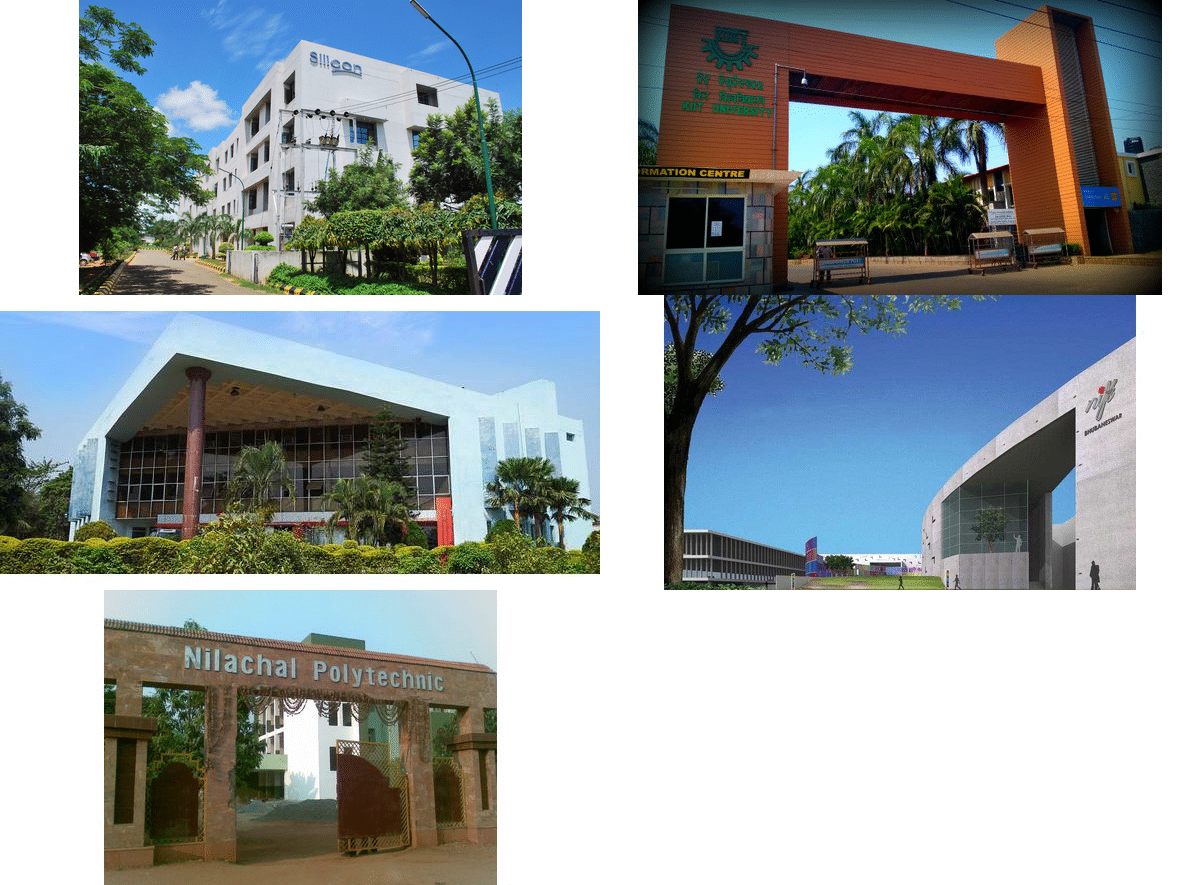
Reputed Technical Institutions like KIIT University, Silicon Institute, Nilachal Polytechnic, CEB, NIFT, and MITS is also largely adding value to this place. Management Institutes like KSOM, BIITM, USBM, Srusti Academy, etc. in this area aspire to put footprints globally creating professional assets and leaders of tomorrow. With quality infrastructure and supported by state of the art technology,all the institute strives to set high standards of education by continuously improving the quality and content of pedagogy.
The Bhubaneswar Development Authority (BDA) has very precisely planned the areas of Patia and Chandrasekharpur to rightfully accommodate the existing populace with adequate residential commercial zones(Retail & wholesale). The working class prevailing are residing in these areas gradually increasing their density. This increase in the density of outsiders has also increased the local vending zones in these areas with few formalities and in-formalities. Damana being an intersection point has been allotted with the retail commercial and business use zone for better flow of liabilities and facilities.
Developmental Plan Area 2030
Being the plinth soil of many one-room startups in their initial phase, C.Spur and Patia area predicts a valuable future for tomorrow's world. The District center situated in Chandrasekharpur inhibits many IT-based and core-based startups trying to surpass their break-even's within a few years, building it to the best place for the nourishment of budding entrepreneurs.
The southern parts of Chandrasekhar face the Rail Sadan attached with the railway quarters alongside the OSAP 7th Battalion and police quarters. The Northside of Rail Sadan faces the OMFED factory making it a small industrial zone distributing dairy products with ease of transportation and coverage.
Fortune Tower is another IT Specific project by IDCO which is situated at a distance of 4.0 Kms from the Chandaka Industrial Estate. It was one of the first IT parks to be constructed at a prime location in this developing side. Right next to it is the Tech Mahindra Campus, which also provides IT and BPO related jobs to the techies in Bhubaneswar. Educational Towers like XIMB, Regional College of Management, ELTI, and NIOS circumscribe the Fortune towers bringing bags of fortune to this area.
This blog will continue describing the developing side in the future Section The Developing side: At a glance. The next episode will include Part:2 of the geographical space tour which will narrate the Old Town and New town Areas of Bhubaneswar.
During old times temples were the hub of gathering knowledge and intellect. Scholars and pioneers used to visit temples to enrich their scope and perspective, in return shared their brains to the eager minds of today. Bhubaneswar, the city with the most number of temples aptly named as the temple city is a home to very recognized stalwarts in every field. It is also elected as the top-ranked in the list of smart cities of India. Best for investments and trades, it is luring many multinational giants as well as skilled personnel with expertise in different sectors to settle in its soil.
Since it is one of the first models of planned cities during the independence riots, it holds a huge potential in terms of resources, geographical plots, roadways, centers of excellence, even market distribution, exemplary infrastructures, and outlying industrial areas. Emerging entrepreneurship environment and budding start-ups will change it to a beacon of developed cities within a few years.
Thus, to look out for a brighter vision, we need to plan it more precisely and it can be only done by brainstorming, analyzing, designing and implementing all changing the aspects practically for the use. The enthusiasm of youth circle along with experiences of the older generation can contribute positively to its cause.
But with pure development comes some debris too. We all need to take care of that simultaneously. Efficient urban planning and development, proper distribution of market and vending zones, matching transport facilities with no traffic issues, proper waste management practices, disaster management schemes(pro and post), good health and sanitation, population reduction, individual identification and information, crime reducing cells, cyber cells, online services, distributed water and electricity services, renewable energy building initiatives, pollution control, afforestation in design etc. , all of these steps need to be taken care of with equal importance to minimize the debris.
In this blog, I will go through all of these points to redesign Bhubaneswar in the best way possible. It will be an elaborate and informative approach based on certain references and assumptions. It can be backed with simulation and survey reports for value-added information. Subsequently, it can be referred by Governing bodies and authorities for practical implications.
This will be a series of blogs with an emphasis on each topic divided into different chapters. I will look over, analyze the problems and will have some solutions regarding the current scenario along with admiration to the existing landmarks.
Here are a few healthy suggestions. Please do follow or pass it to the concerned authority which/ who could really make it happen.
1. There should be a rule for every street food vendor as well as shopkeepers keeping food items. There must be a dustbin in front of their vending area else their license should be canceled or a fine amount shall be charged by the municipality.
2. The dustbins and their color codes are mostly unknown to common people. So it is needed to be written over the bin, the type of waste to dispose of it.
As per the pollution board of India, there are certain color codes and they are as follows:
Green Bin: The green colored bin is used to dump biodegradable waste. This bin could be used to dispose off wet/organic material including cooked food/leftover food, vegetable/fruit peels, eggshell, rotten eggs, chicken/fish bones, tea bags/coffee grinds, coconut shells and garden waste including fallen leaves/twigs or the puja flowers/garlands will all go into the green bin.
Blue bin: The blue colored bin is used for segregating dry or recyclable left over. This category includes waste like plastic covers, bottles, boxes, cups, toffee wrappers, soap or chocolate wrapper and paper waste including magazines, newspapers, tetra packs, cardboard cartons, pizza boxes or paper cups/plates will have to be thrown into the white bin. Metallic items like tins/ can foil paper and containers and even the dry waste including cosmetics, hair, rubber/thermocol/polystyrene), old mops/dusters/sponges.
Black bin: Black bin, make up for the third category, which is used for domestic hazardous waste like sanitary napkins, diapers, blades, bandages, CFL, tube light, printer cartridges, broken thermometer, batteries, button cells, expired medicine etc.
3. The gutkha and cigarette vending zones must have dustbins and should insist consumers to use them.
4. Apartments and flats are better in waste management but they put all the wastes outside their premises. Each apartment must have common large bins which should be emptied by Municipal waste carrying trucks daily or time to time.
5. The other localities with single or independent houses must know the benefits of waste management and awareness campaigns must be held by govt. time to time to encourage the use of bins and proper disposal.
6. We must know the difference between different types of wastes and how to use them. Wet and degradable trash like vegetable wastes, waste food materials etc.can be dug in a pothole to make manure. Proper procedure must be made aware to all the citizens so that they could get benefits.
7. Recycle, reuse and replenish. Innovative waste management plans like reusing shredded plastics to make roads, bottles to make the overhead canopy for pedestrian etc. can be implemented in the localities.
8. Each block or locality should have a waste management team, which will encourage the whole locality to apply these rules by awarding and awarding the localities.
Few more suggestions for every individual
1. Install 2 dustbins in your home. One for organic wastes and the other for inorganic waste.
2. Make a small garden on your terrace, balcony, side skirts of your house and use the organic wastes as a manure there.
3. Use less papers, use the word, excel, PowerPoint, sticky notes etc.as replacements.
4. Drive less and when needed in your gasoline or diesel vehicles. Use cycles or electric bikes and for distance in between, 1 to 2 km go for a walk. Walk to get your grocery, walk to get your stationeries.
5. Don't spit outside in a plane area, spit near the shoots n roots of a tree. Chewing tobacco is bad and will harm you personally but spitting it anywhere will harm the environment and other people too. Mostly people who can't get their ass up to find a place to throw tobacco, spoit it at corners of public bulidings and heritages which is a crime too. Be careful with that.
6. Take cloth bags or cotton fiber bags to get your groceries and avoid plastic bags as much as you can.
7. Dispose of plastics to dustbins only. If you don't find one, hold it until you find one. Check whether the dustbin where you are disposing the plastic is the right one. You can do that by checking its color codes.
8. Don't defecate in open areas, use a toilet. In cities, there are numerous defecating centers placed by Govts. Use them. Find the nearest public toilets in google maps with your smartphones and do make it a habit when you visit some other place.
9. If you are going for any construction work, then disperse the sands and gravels in a bounded area. Cover the area with jute sacks so that the dust can't get mixed up with the surrounding air. If possible make the sacks wet by sprinkling water on them that will keep the sack intact and no specks of dust will be out.
10. Reduce using high decibel modified silencers, people around get irritated not fascinated. If you really want to show your presence then use stock silencers under the restricted decibel. 80 decibel is the maximum noise limit for motorcycles and scooters but modified silencers go up to 130, so please check it.
11. Do pollution check of your vehicles from time to time. If you find any black or grey emission of smoke please take it to a garage for repair.
I would request the Municipal corps., environmentalists and other eminent person related to taking strict actions because of its the need of the hour.